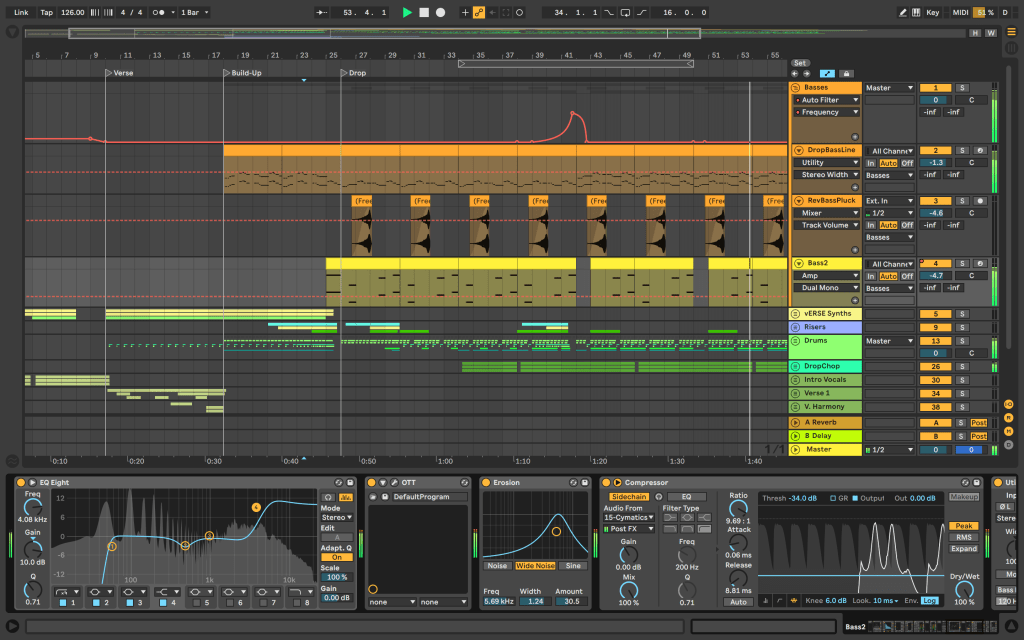
These videos and the screenshots in this blog demonstrate the progress of the house track in terms of editing and arrangement of the track. The first video shows the first initial ideas and how me and Connor started with a very simple sounding bass line and other instrumentation like the drums for this track.
We then developed this further, editing the bass to sound more fitted to the genre (see video).
BASS:
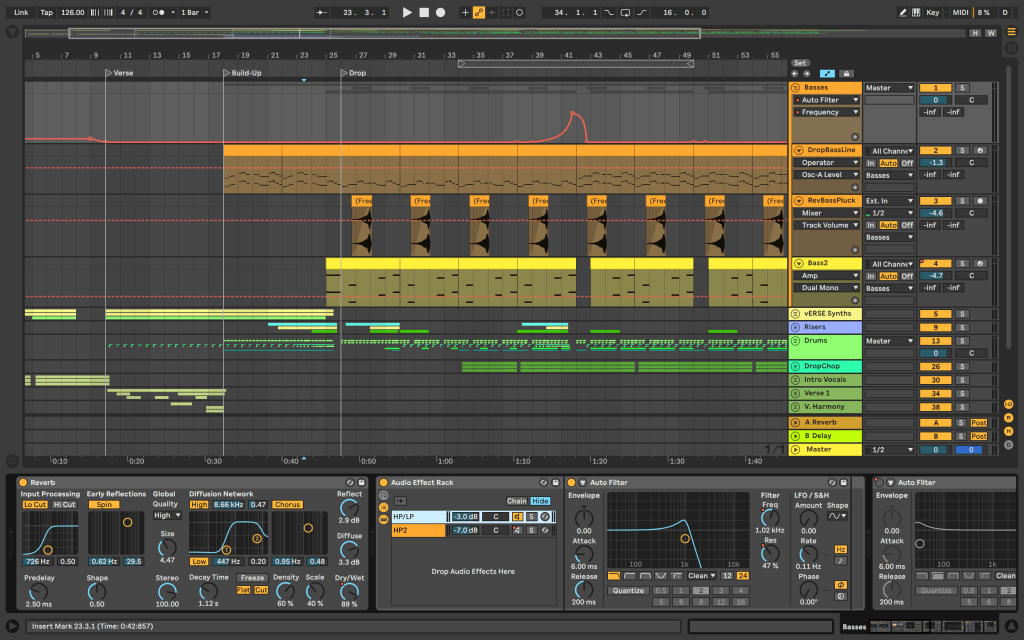
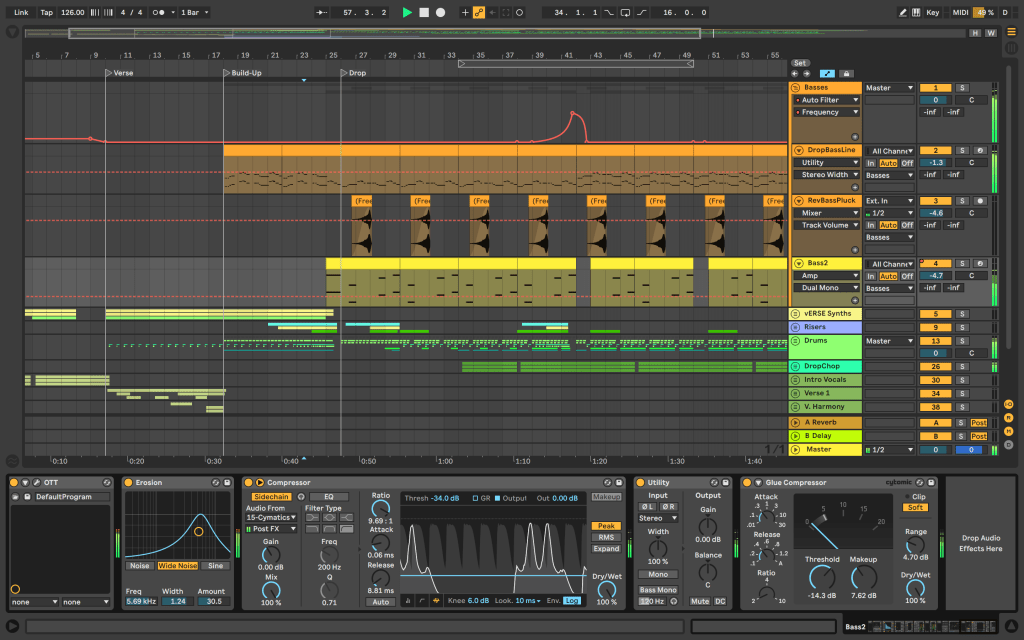
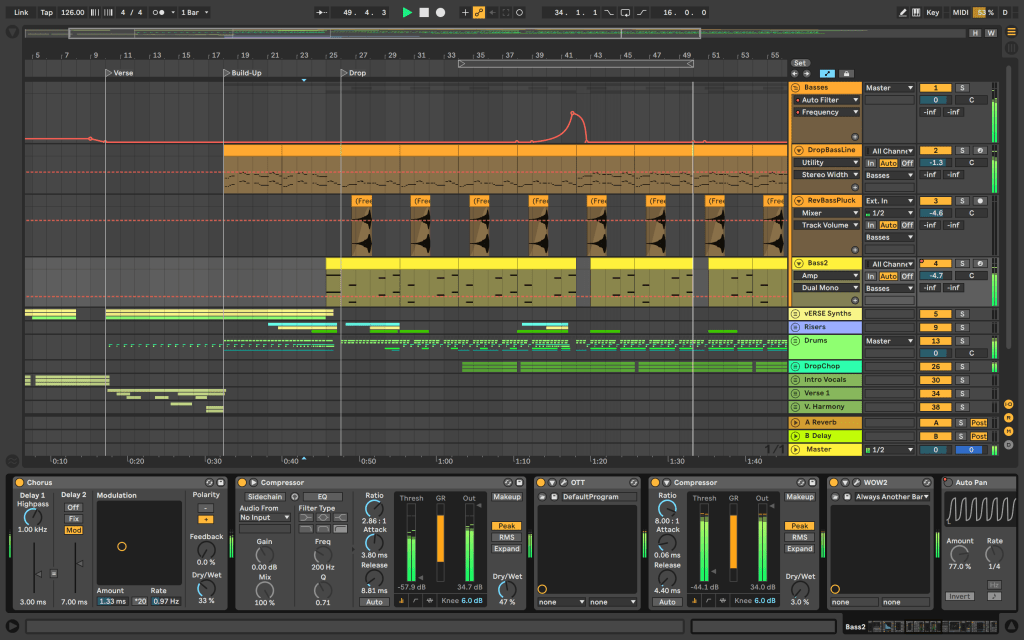
The counter bass was created to respond to the more lead-like bass that holds the melody. This was formed to be dark, gritty, and heavily compressed in order to achieve a more modern sounding bass, particularly to fit within the genre of House/Dance.
It is the same tone per chord i.e. on the Cm chord, however, programmed in 2 C notes an octave difference between, and so on following the scale.
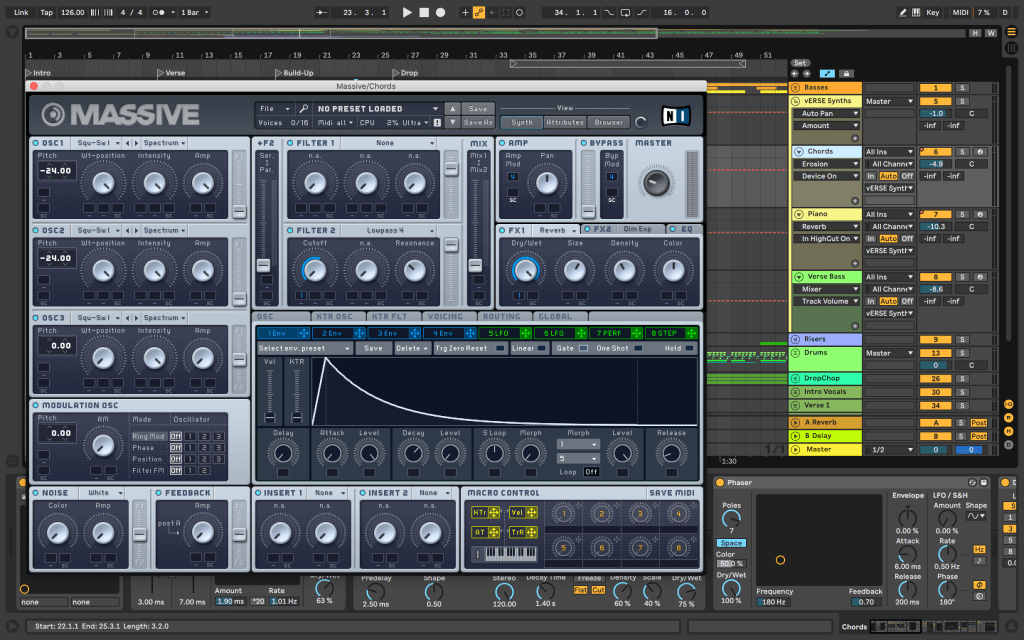
Added simple detuned saw wave patch in the synthesiser ‘Massive’ by Native Instruments; layering this with a reese-style bass (from the same synth) – This helped to fill out the bottom end, and increase the body of the sound.
EQ – boosted the low shelf, and cut out some more highs in order to tone back some of the fuzz from the bass.
Processing this bass involved a lot of distortion and compression, followed by a phaser and chorus plugin, to add some movement and tonal quality to the bass – a staple for bass sound design.
Used some more ‘multiband’ compression, as well as a filter/distortion plugin, WOW2, which squashed the sound, giving it a modern feel followed by some general additive and subtractive EQ.
Width control and a touch of compression to create thickness the overall sound up.
DRUMS:
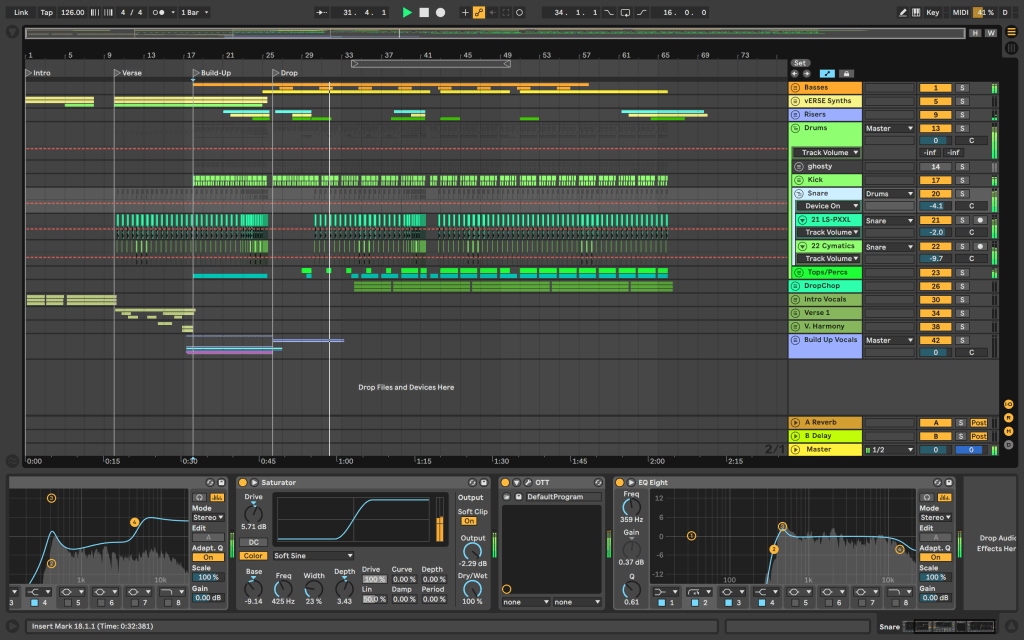
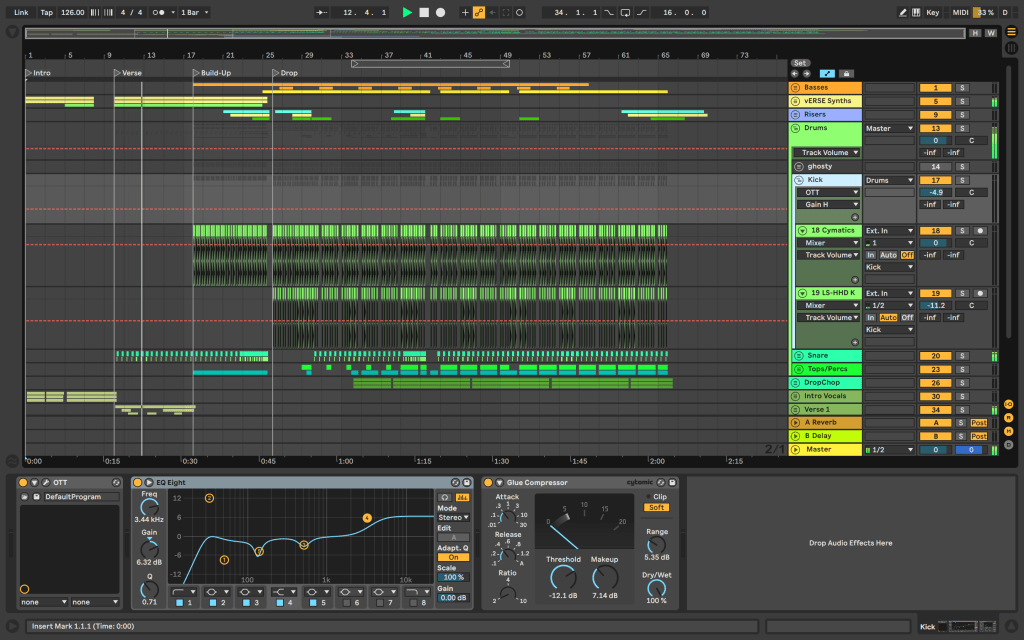
Every 8-16 bars of drums (common in house tunes)
Creates a sense of progression, and to an extent tension also, as you can sense the song leading somewhere.
These contain a lot of high-end energy, and add a characteristic to the sound of the kick drum that makes it sound somewhat organic, as well as energised and fully fleshed out.
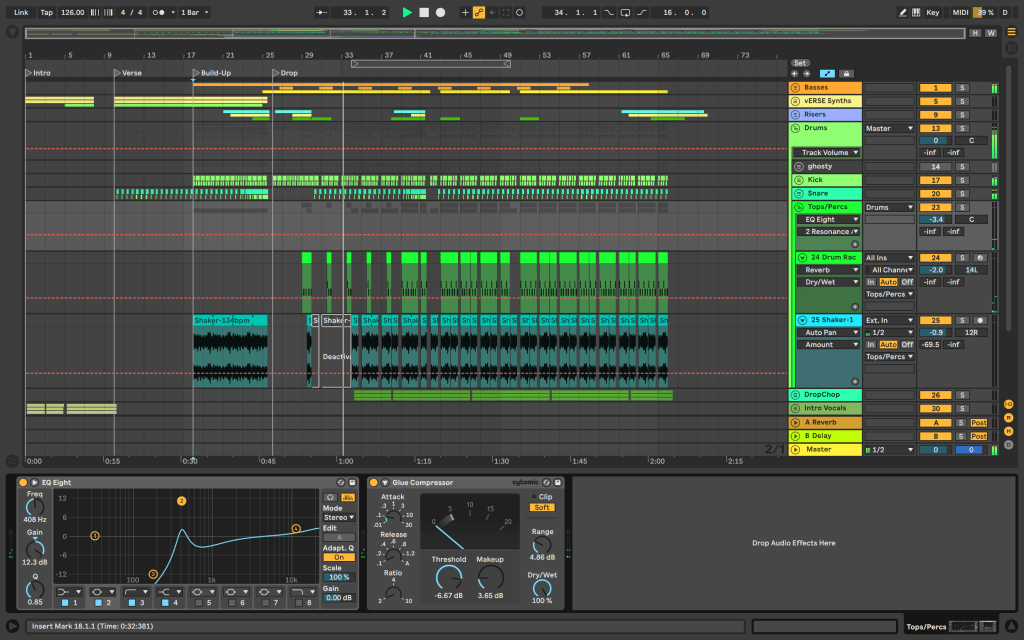
For the top-end percussion, in this case the hi hat and shakers created to something more organic sounding.
Carries rhythm, and is what characterises the ‘2-step’ or shuffle beat.
Processing on these parts was minimal, save for automatic panning and delay on the shakers, as well as a touch of reverb on both channels.
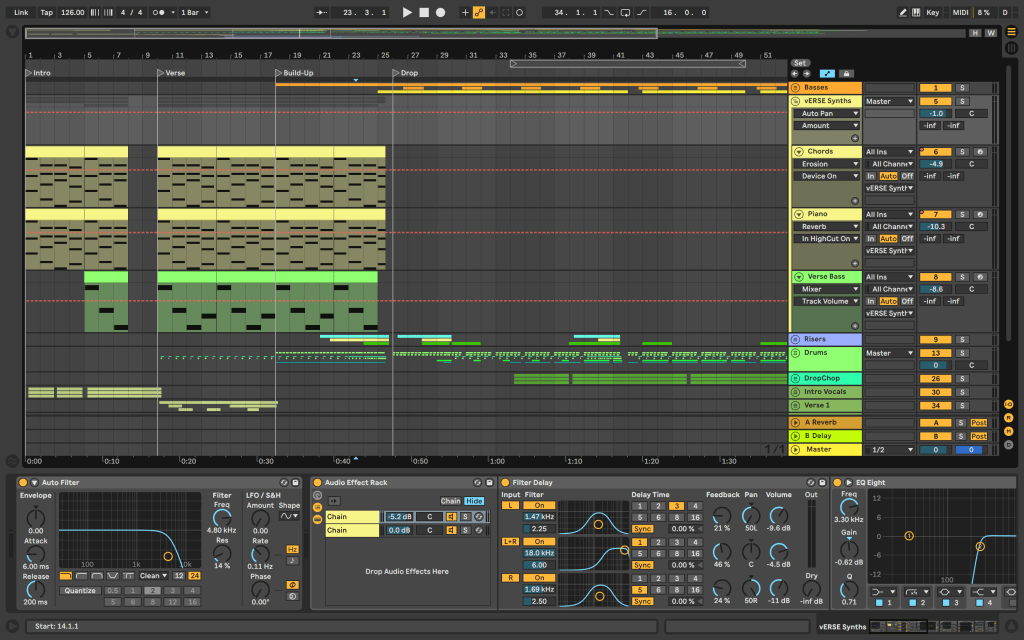
VERSE SYNTH:
Continued the same synth patches already used in the intro
Opened up the bottom end slightly more, which is audibly noticeable as the song transitions.
CHORUS INSTRUMENTATION
Created a lead, which carries the melody throughout this section.
Operator, an FM synthesiser, with the 2 oscillators in use simply being pure-tone sine waves.
After some distortion and processing – applied a plate reverb (taken from older techniques wherein one would play a sound that would reverberate between 2 small plates, close together).
Giving it character and added much to the overall finished sound itself.
EQ’d, compressed, added a side chain reverb to the sound to fill out the space (as well as some more reverse reverb throughout) followed by side chain compression to the kick and counter bass heard in the track.
What Next?
Begin to write the lyrics and melodies for this track(Maybe create some acoustic version as a starting point)
Continue to work and produce the other songs
Continue to work with Alex on the EP cover – colours, fonts
BLOG 9 – HOUSE/DANCE SONG: [ABLETON]
Although me and Connor have formed various chord progressions as a starting point (in blog 6), we wanted to come back to them later and begin to form the first initial ideas for the first track – house/dance track.
TRACK RESEARCH:
Below are a selection of House/Dance tracks we have looked at as references in terms of production and instrumentation.
Meduza, Goodboys – Piece of Your Heart
Source: Youtube – Jax Jones, Martin Solveig, RAYE, Europa – Tequila
Source: Youtube – Jax Jones, Martin Solveig, Madison Beer – All Day And Night
SONG STRUCTURE:
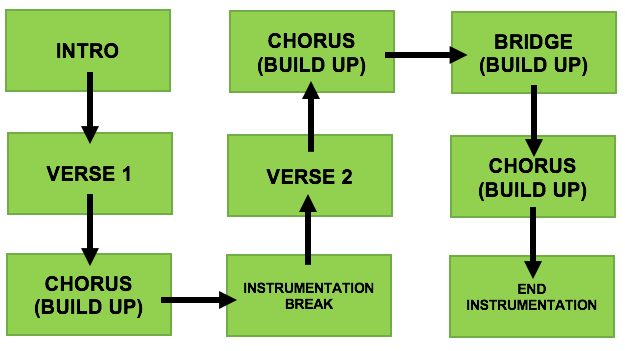
For this track, we will be creating the structure, instrumentation and chords as apposed to creating the lyrics and chords first. Below is the overall structure that we will create for this track.
Figure 9.0. – Song Structure
Adapted from: Subaqueos, n.d. and Cymatics, n.d.
Below demonstrate the sound samples that we have formed which are simple melodic elements and some FX editing that has been applied to these instruments as a starting point, something which Connor did at an early stage to help demonstrate to me the varying techniques in how to do this.
CHORDS + MELODIC ELEMENTS
Basic chord progression – C Harmonic minor scale
Added Reverb to bass
Plate Reverb – Uses small side room size: 0 decay time and Fixed into stereo instead of mono, giving a ‘donk’ sound.
Using filter – low passing in on one part – This is so it doesn’t sound muddy
Further editing needed
Added reverse reverb on bass
Bass like pluck
DRUM ELEMENTS
Layering drums, added EQ
Upward compression on high hats – sounds more organic, small reverb size
Snare & Shakers – Panning to add movement and delay
EQ out the lows – OTT compressor
Now that we have created these varying elements of the track, referring back to the six steps (blog 4), below is the track formed all together where we have created the song, focusing on chords, structure and arrangement of instruments.
The production also demonstrates how the use of low fi filter has been used simply as a beginning element to the track. Low fi is achieved through ‘bit reduction, sample rate reduction, and saturation’ (Savage, 2014, p.117). This has been experimented with during the beginning of the track to bring the listener in.
What Next?
Now that our ideas are in place for the first track of the EP, it is now important to continue the development of this track.
Continue to work on this track – instrumentation & structure
Begin to form the lyrics and melodies after first step is complete
Jax Jones. (2019). Jax Jones, Martin Solveig, Madison Beer – All Day And Night (Late Night Session). (Online Video). Available at: https://www.youtube.com/watch?v=jfreFPe99GU [Accessed March 3rd, 2020].
Meduza. (2019). Meduza, Goodboys – Piece Of Your Heart (Visualizer) ft. Goodboys. (Online Video). Available at: https://www.youtube.com/watch?v=KWjV25q34Hw [Accessed March 3rd, 2020].
Savage, S. (2014). Mixing and Mastering in the Box: The Guide to Making Great Mixes and Final Masters on Your Computer. Oxford: Oxford University Press.
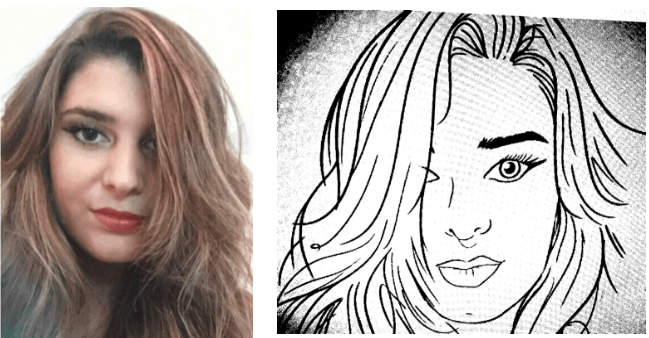
Now that me and Alex have gained an idea into what I am hoping to achieve for the Album cover, I will be working with him to create some drafts and previews. Below is a starting point where Alex has illustrated a photograph of myself (reference photograph on left) which I am extremely pleased with!
Figure 8.0. – First Preview
Photograph and Illustration
ELEMENTS – COLOUR & TYPOGRAPHY/TEXT FONT:
It is important to consider varying aspects/elements like colour when designing an album cover, and as Kipp (2018) states: ‘There are several elements that come into play for every album cover, from the colors and imagery used on the front cover to the typography and text on the back’. Kipp also considers to create something that relates to you as a person, and in this sense, I am hoping to incorporate some Greek designs.
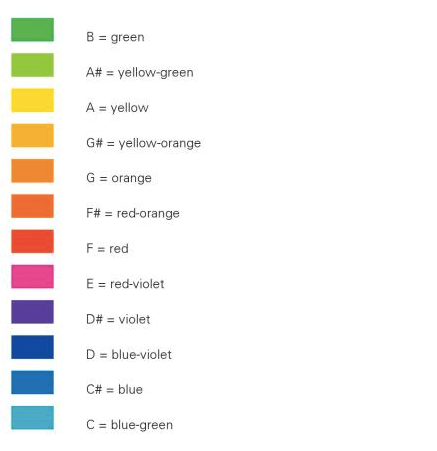
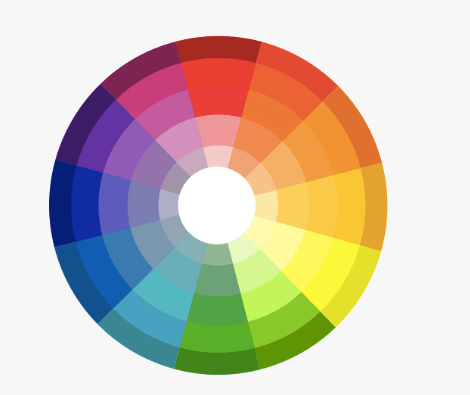
Below is an interesting concept that Mehl (2013, p.158) suggests to use and states that ‘the relationship between music and color has been, and continues to be, an inspiration to musicians’. Dulux (n.d.) also suggests that mixing varying colours like dark or light can create ‘interest and a touch of energy’, which I hope to incorporate in some way.
Figure 8.1. – Colour Scale to twelve-note scale
Source: Mehl, 2013, p.158
This could be something I could explore or experiment with in the sense of creating a song in a specific key, e.g. A major and create the cover to be in yellow as shown above. However, this will depend on the sort of sound I am hoping to achieve for the EP tracks and this may be difficult to interpret.
Figure 8.2. – Primary Colour Wheel
Source: Dulux, n.d.
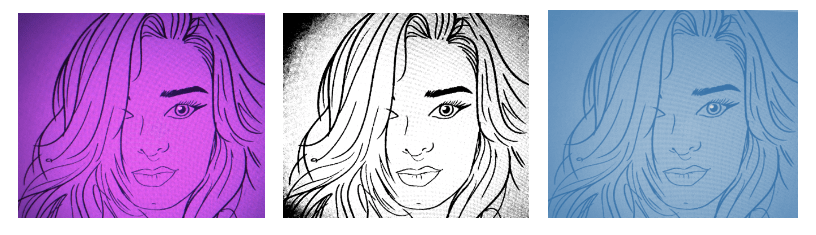
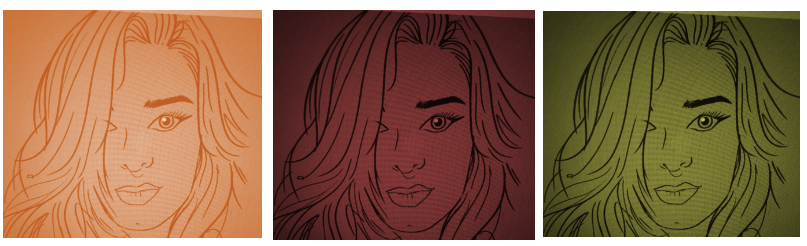
In order to consider what sort of colours work well with this illustration as a starting point, below are some primary colours that we have experimented with: purple, black and white, blue, orange, red and green. A variety of colours which have been taken from the wheel colour theory.
Figure 8.3. – Illustration Exploring Colours
Colour Experiment of Illustration
FONT IDEAS:
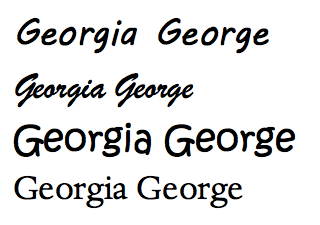
In terms of font, we have also discussed how I would like my name to look. Below are a few examples that we have looked at as suggested by Alex. This will also need to be tested in the next preview of the cover.
Figure 8.4. – Fonts
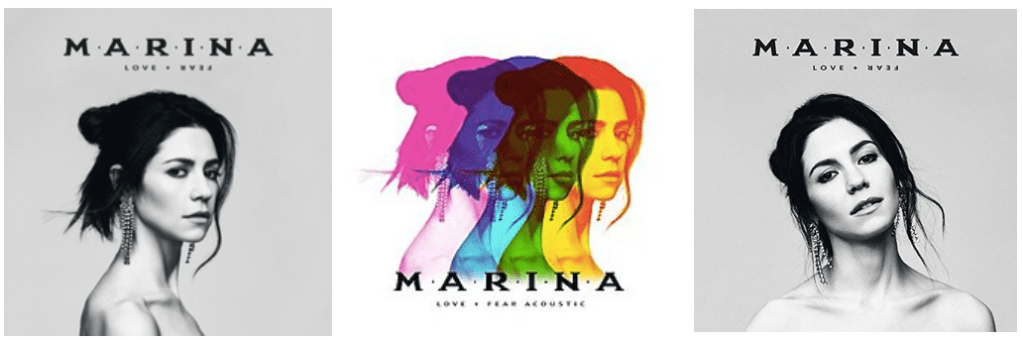
Figure 8.5. – Marina Album Covers (Love, Fear and Acoustic Version)
Source: Marina Website
I have also looked at the artist Marina as a reference and inspiration for my cover who is also a British Greek singer and has incorporated a Greek style font on her recent album ‘Love and Fear’ (see figure 8.6.). The middle cover also demonstrates how she has used various colours for her acoustic album, demonstrating that several colours can work well together, rather than just one.
From this updated preview/session, I am extremely pleased so far with our collaboration! This gives me some form of hope that the final outcome will be achieved positively. Alex has also guided me through and has allowed me to gain a sense of what entails with being an artist.
What Next?
Now that Alex has been successful in illustrating a photograph of me as a starting point, the next steps are to:
Choose the colour
Decide on a font
Further work on what I would like to be shown on the cover
Mehl, R. (2013). Playing with Color: 50 Graphic Experiments for Exploring Color Design Principles. Rockport Publishers.
BLOG 7 – ALBUM COVER RESEARCH
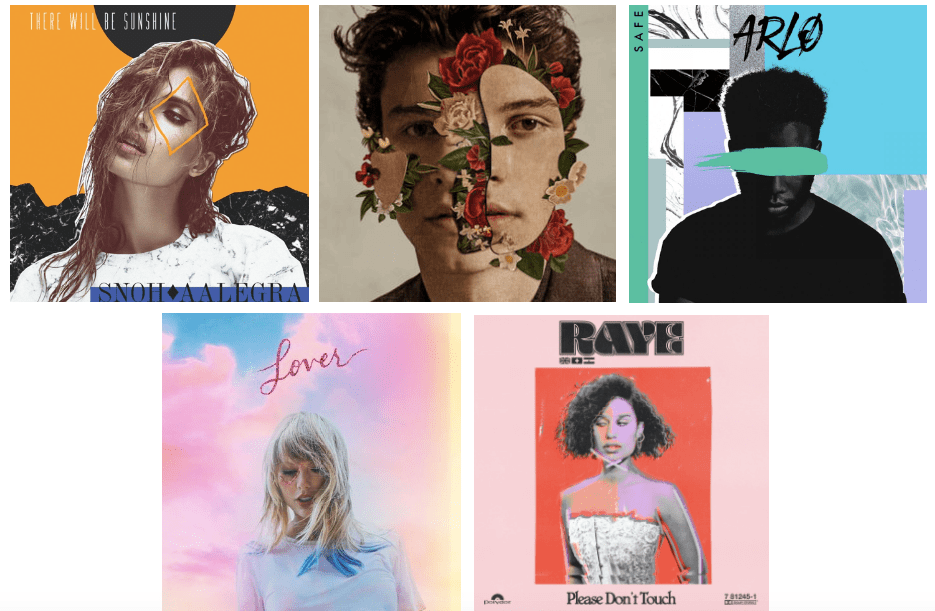
In order for me and Alex to gain an idea into the area we would like to take this EP cover, I firstly researched and looked into album covers from a variety of artists. I also wanted to look into only illustrated album covers to see what has been created in industry. Below are some examples that caught my eye –
PHOTOGRAPHS + ILLUSTRATION:
Artists Album Covers – Snoh Aalegra, Shawn Mendes, Arlo, Taylor Swift, Raye.
The album covers above, have been created with both photography and illustration, demonstrating two areas of media that have been combined to form something unique and eye catching. The Shawn Mendes cover (second cover) most especially caught my eye, mainly due to the illustrated flowers, something that I could possibly incorporate in my cover.
MAINLYILLUSTRATION:
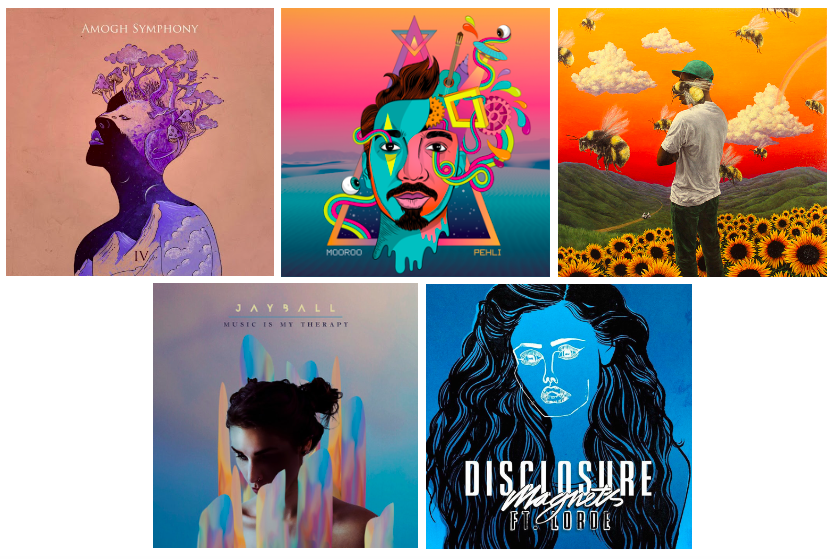
Artists Album Covers – Amogh Symphony, Mooroo, Tyler the Creator, Jayball, Disclosure ft. Lorde.
Now that I have gained an insight into varying album cover designs, I am mainly interested in the aspect of illustration, in this case, without the photograph element. I am particularly intrigued by the last one (Disclosure Ft. Lorde) whereby the illustrator has drawn the singer Lorde. Although I will be eliminating the idea of using photography, I believe a photograph can be still involved through Alex illustrating an image of me.
CREATING AMOCK UP
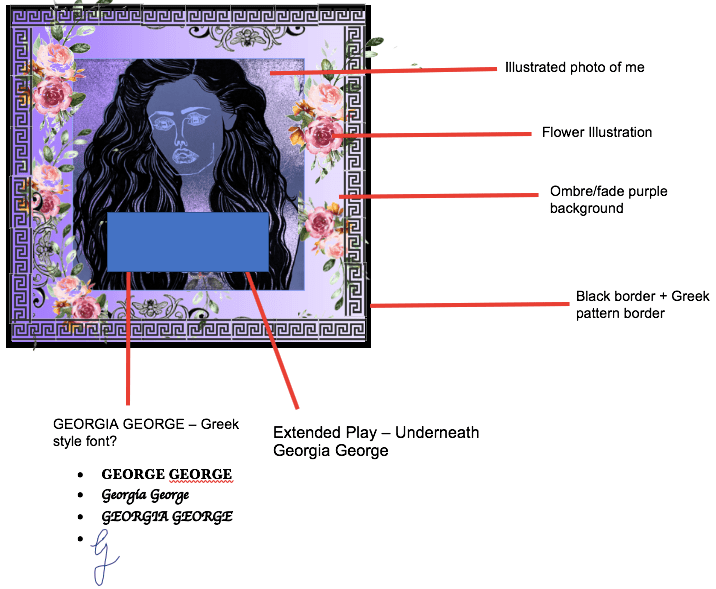
Below is a ‘mock up’ I have created with Alex in order to gain an idea of the style I am hoping to achieve. I have also used the Lorde illustration as a reference. This will help us both in the process when creating the cover.
In order to make this album cover unique, especially to me as an artist and wanting to stand out, I wanted to incorporate some form of Greek elements. By doing this, we have included a Greek patterned border and will further explore Greek style fonts in the process of creating previews/drafts.
COLLABORATIVE CHECK:
Because we will be collaborating through Facebook and Skype, it is important that we are still able to work together on this project effectively. Although it may not be as effective working online rather than face-to-face (as me and Connor are doing), Hutt (2017) states the positives that may be achieved through collaboration online, this has also been adapted with my own ideas:
Easier managing the project
Quick messages – can message with ideas at any time, with quick responses
Easily able to send links, videos, share picture, any ideas
Screen sharing via Facebook – Able to see progress, have input
Complete project quickly – Finish by May 7th
Save money – Don’t have to travel to where Alex
Adapted from: Hutt, 2017
From this session and producing a mock up with Alex, I am very pleased and believe that this will create something very positive! Alex has also shown his interest in this project and has a very professional attitude when collaborating with other individuals.
What Next?
Continue working with Alex on the ideas – Create previews/drafts and discuss
Work with Connor now to form varying ideas for different tracks – Could relate to the ideas that have been made for the EP cover? – Look into this.
The methodologies that need to be explored within album production, are dependent on the type of sound I am hoping to achieve. For this EP, I am hoping to go down the root of a creating 4 songs in a range of genres. For example, Pop, Dance and RnB, mainly styles that are related to the current charts. This will also be helpful in finding my own sound in music and gain various ideas when collaborating with Connor and his personal favoured genres.
SECOND MEET UP
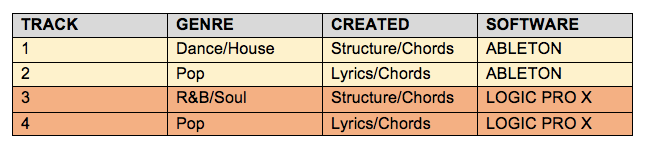
For our second session, we came to the conclusion that we will be creating two songs on Ableton and two songs on Logic Pro X. This will allow us both to gain important experience, skills and techniques by creating tracks in different DAW’s, enabling us to be experimental.
In terms of creating each song, we will experiment with:
Track 1 and 2 – Inputting, chords, instruments and structure into DAW first
Track 3 and 4 – Creating the lyrics and chords first on paper
Below is a table demonstrating these ideas (see fig 6.0.)
Figure 6.0. – Track Plan
By doing this, it will also allow us to gain an insight into which technique is more efficient in the creative process. Normally, when creating my own music, I create the whole track first through chords, instrumentation and structure into the DAW and then create the melodies and lyrics last. When Connor creates music however, he creates the chords and the lyrics first. This is a great opportunity for us to both learn and experience how we create music through each others personal techniques!
Many musicians have questioned the approaches to song writing, and Mids (2016) discusses this in terms of which comes first, music or lyrics. This is further highlighted by The Recording Revolution (2014):
Music First:
‘give the listener a clear and memorable hook that sticks with them for a long time to come’
Harder to write lyrics to fit melody and might not be able to create something catchy or memorable for the listener
Lyrics First:
‘gives you a song that has clear direction lyrically, with a concrete theme or idea’
Difficult to create a melody that fits around the lyrics
During our second meet up, we begun to construct some chord sequences, inputting them into Ableton to put these ideas to the test. Below are some videos demonstrating this.
Own Video (Chords 1) – YouTube via Georgia George Channel
Own Video (Chords 2) – YouTube via Georgia George Channel
We discovered that the first set of chords were nicer to work with in terms of creating a melody and forming other instrumentation. We inputted them into Ableton and started to experiment by adding a simple drum beat on top of the chords as a starting point. As this was just a practice, this allowed me to learn the basics of how Ableton works, a software that I have not used before.
Own Video (Ableton 1 Chords) – YouTube via Georgia George Channel
COLLABORATIVE CHECK:
From this second session, we have been able to collaborate in a very positive way by sharing both of our techniques and ideas that can be put forward. Connor is also very helpful in terms of guiding me to understand and learn new skills, especially as my experience in album production using Ableton and Logic is still at a beginners stage!
‘Collaboration is an extra pair of ears, hands, and an additional brain to work with. It gives you VIP access into someone else’s workflow. It helps you overcome creative blocks. It even brings out creativity you didn’t know you had’. (Trandafir, 2016).
What Next?
Continue to create EP ideas
Begin to collaborate with Alex on the EP cover – Create ideas
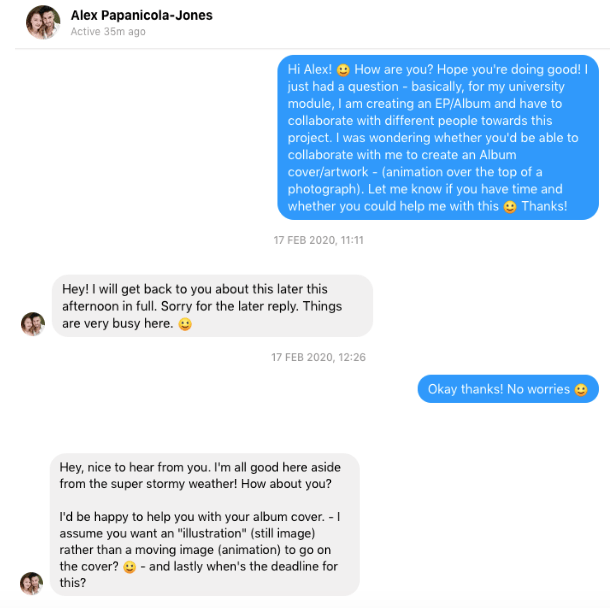
Now that I have found a music producer, I wanted further my exploration to find other people who I could possibly collaborate with. For example, I thought it would be a great opportunity to work with someone to create an EP cover. I decided to get in contact with a professional illustrator and animator Alex, who goes by the name of ‘ScribbleStache’. I spoke to Alex via Facebook to discuss whether he would be interested in collaborating with me.
From this, I further looked into Alex’s previous work on his website, giving me insight into the areas of work he has created and who he has worked with. This also includes various types of illustration and animation he has created! (See video below).
Source: YouTube – ScribbleStache Showreel
EP COVER ARTWORK RESEARCH (STARTING POINTS):
As a brief starting point, these are the main areas I need to look into when working with an artist to create an EP cover:
Research Album Cover – Other artistsinspiration
Methods – Sizing, text/font
‘Guidelines’ – Unique cover, copyright
Source: PQ, 2020
COLLABORATIVE CHECK/IDEAS:
Because of the distance between me and Alex, it is important that through online resources and social media platforms, we are still able to collaborate effectively. As highlighted by Donelan (2012):
‘computing and communication technologies haveprovided us with useful and powerful information resources, remote instruments, and tools for interacting with each other’.
Although there are many positives to collaborating online, there are some issues that may arise when trying to communicate:
Effective communication/interaction – reliability, availability to reply
‘Expressing opinions’ – not being able to see each other face-to-face, honesty and personal opinion
Adapted from Source: Wolf (2013)
These issues will be resolved by speaking through Facebook messenger, sending each other documents through email or on Skype/telephone call. Razmerita (2013, p.1) further suggests that: ‘social media enables a new model of managing knowledge that involves formal and informal communication, collaboration using a variety of applications’ showing that online collaboration can be used both positively and successfully.
What Next?
Now that I have found an illustrator who could potentially help me to create EP artwork, I need to research and create a plan or ‘mock-up’ of what I am hoping to achieve. I also need to look into the direction I would like to take the artwork.
Research into album artwork
Create a ‘mock up’
Carry on with first initial ideas of EP – Continue this with music producer
Reference List:
Donelan, H., Kear, K., Ramage, M. (2012). Online Communicationand Collaboration: A Reader. Oxon: Routledge.
Razmerita, L. (2013). Collaboration Using Social Media: The Case of Podio in a Voluntary Organization. Department of International Business Communication, Copenhagen Business School. Collaboration and Technology, p.1-9.
In order for this project to be achieved successfully, I will be conducting research throughout the process of this EP creation. To gain an idea of the concepts of creating an EP, this particular blog will demonstrate different ideas and techniques as an initial starting point.
PROJECT AIM: WHERE WILL THE TRACKS BE POSTED?
Because I have now found a music producer to work with, my main aim is to create an EP of four tracks which will then be released on various social media platforms i.e. Facebook, Instagram and Twitter. The main music audio platform called Soundcloud, is where I will be submitting the final project realisation. I believe that Soundcloud will be the most successful in gaining listeners, this is mainly because I can post a Soundcloud link of the tracks directly onto other social media sites (Baby, 2012). Hiebner (2014, p.7) further emphasises that Soundcloud can be used ‘to promote your own creativity’.
Soundcloud is also an excellent platform for artists who are first starting out on the music scene or who are independent (Oswald, 2018, p.88). The platform also offers a free total of 180 minutes upload time (Soundcloud, n.d.), which is great for those who are just starting out or who cannot afford to pay a monthly subscription. This is particularly well suited for myself due to currently studying. Soundcloud has worked positively for upcoming artists like Jorja Smith where her single ‘Blue Lights’ (CAPITAL XTRA, 2019) became a hit (see figure 4.0.) as well as artists like Billie Eillish whose song ‘Ocean Eyes’ (see figure 4.1.) became popular hit and sparked her success as a musician (Marsh, 2017).
Figure 4.0. – Jorja Smith ‘Blue Lights’
Source: Soundcloud – Jorja Smith
Figure 4.1. – Billie Eilish ‘Ocean Eyes’
Source: Soundcloud – Billie Eilish
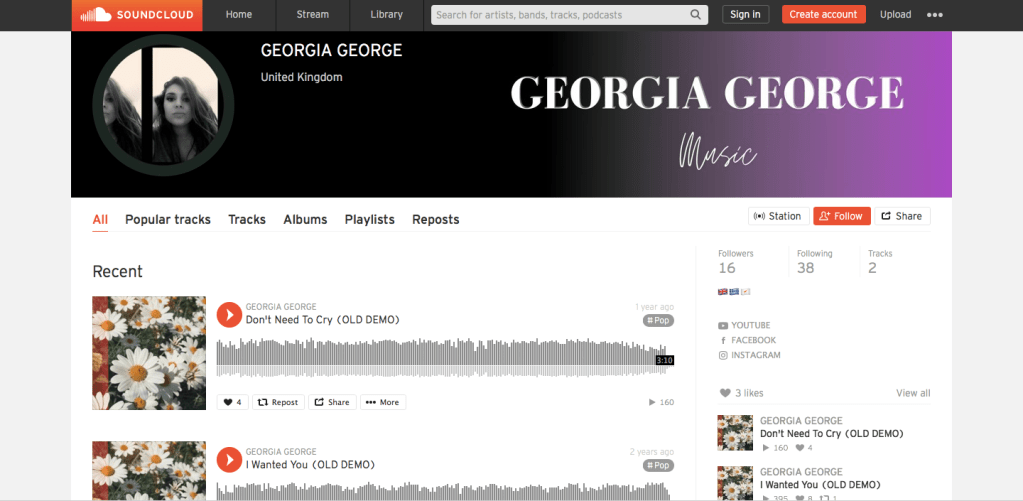
My Soundcloud Profile:
Because I have experience with Soundcloud in the past (with one song at nearly 400 listens), I believe that this platform has worked positively, especially because I was able to directly share the link to other social media pages, e.g. local Facebook pages like ‘Teignmouth Oracle’ and pages like ‘Greek Cypriots Growing Up in the U.K.’ where I am able to target a wide range of audiences to gain exposure.
Figure 4.2. – My Soundcloud Profile
Source: Soundcloud – Georgia George
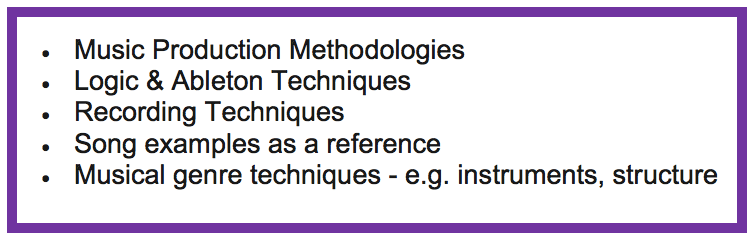
Another goal to gain from this project is to find my own individual sound of music, enhanced with Connor’s personal styles that he composes in. This could possibly be made up of a mixture of genres or even go down the root of one specific genre like Pop. However, it is important that I firstly research into these styles and methods (see figure 4.0.)
Figure 4.0. – Research Ideas
To understand the concept of creating an EP, I want to gain an idea as to what they are used for. This is expressed by Letang (2019) who states that:
‘the EP is great as a promotional tool. While singles are quick and easy to create, they don’t give people a full idea of what you can do’.
I found this particularly positive as it demonstrates great opportunity to explore varying genres and musical ideas that me and Connor will have in mind.
METHODOLOGY– MUSIC INDUSTRY
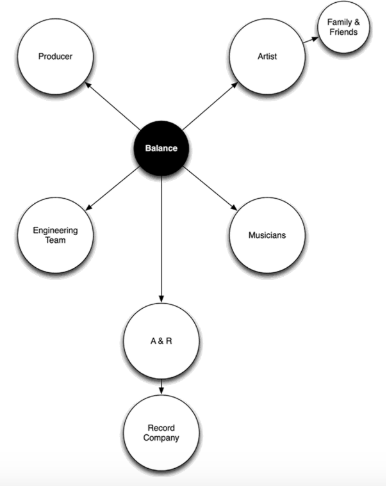
From a more professional perspective, Golding et al. (2012, p.23) highlight that, in order to become successful in this field, it’s important to maintain a well balanced lifestyle (see figure 4.3.).
Figure 4.3. – Balance and Key to Success
Source: Golding et al, 2012, p.23.
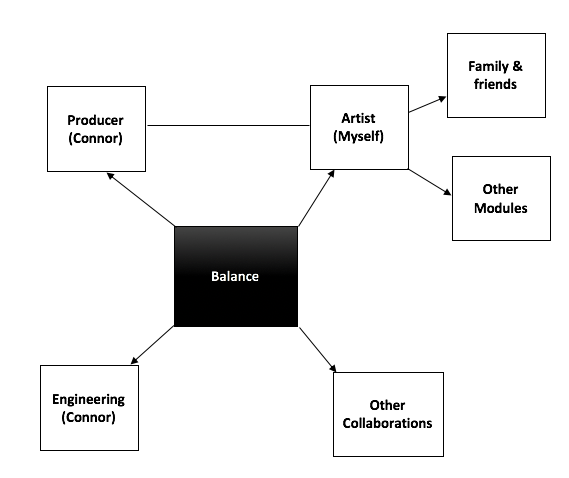
But because this is a university project, I have created my own diagram that demonstrates how I will keep this project well balanced in my personal situation and, along side other university modules (see figure 4.4.).
Figure 4.4. – Personal Balance
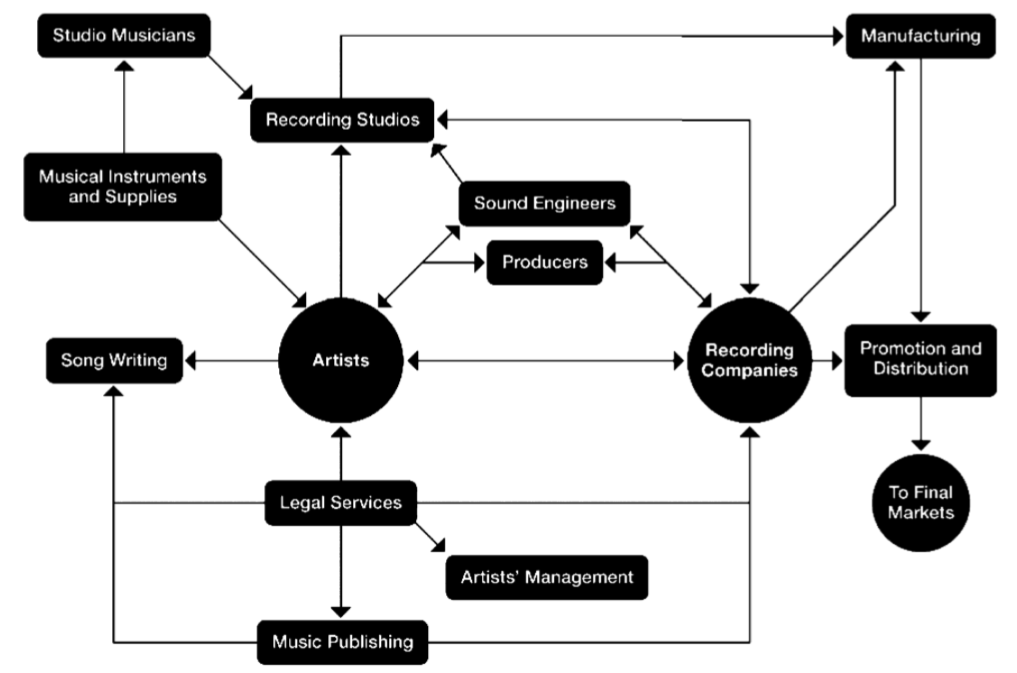
Hracs (2012, p.444), further adapts these ideas emphasising what artists and majors should consider in terms of recording studios, companies, promotion and more (see figure 4.4.).
Figure 4.4. – Traditional Model Controlled by Majors
Source: Hracs, 2012, p.444
This allows me to gain a greater understanding of the music industry and shows that there is a bigger picture to music rather than just going into the studio. This is further highlighted by Weisman (2013, p.66) who emphasises that there is a lot that entails with being an artist and wanting to be successful in the music industry, rather than ‘just going into the studio with a producer and making beats’.
It is also important to consider other areas that professionals have to deal with in the music industry. For example, copyright and ensuring that mine and my collaborators music is protected. PRS for music (n.d.) suggest that ‘copyright of a musical work begins automatically once a piece of music is created and documented or recorded’. Marshall et al. (2013) further emphasise that copyright is an extremely complex area of study. This will be further examined in future blog posts to ensure that our creations are protected.
ALBUM PRODUCTION METHODS – STARTING POINTS
As a starting point, this is a brief overview of the main areas that me and Connor need to explore when creating the tracks as suggested by Leviatan (2017) –
SIX STAGES:
‘Songwriting’ – Chords, Melodies, Lyrics
Arrangement – Instruments, Vocals
‘Tracking‘ – Recording
‘Editing‘ – Adjustments, Tidying
‘Mixing’ – Dynamics
‘Mastering‘ – Final Sound
Adapted from Source: Leviatan, 2017
What Next?
Now that I have done some brief research into creating an EP, it is now important that I follow these areas up and begin planning to form tracks with the music producer.
Further research into methodologies of album production
CAPITAL XTRA. (2019). Jorja Smith On Her Journey So Far | Homegrown | Capital XTRA. (Online Video). Available at: https://www.youtube.com/watch?v=zYIQKakSJZY [Accessed 2nd May, 2020].
Golding, C., Hepworth-Sawyer, R. (2012). What is Music Production?: Professional techniques to make a good recording great. Oxford: Taylor & Francis.
Hiebner, S., Hiebner, H. (2014). Social Media for Musicians: SoundCloud. Cengage Learning Trade.
Hracs, J.B. (2012). A Creative Industry in Transition: The Rise of Digitally Driven Independent Music Production. Growth and Change. Vol 43, No.3 (September 2012), pp.442-461.
Weisman, L. (2013). The The Artist’s Guide to Success in the Music Business: The “Who, What, When, Where, Why & How” of the Steps that Musicians & Bands Have to Take to Succeed in Music. Texas: Greenleaf Book Group.
BLOG 3 –AIMS & OBJECTIVES + FIRST SESSION
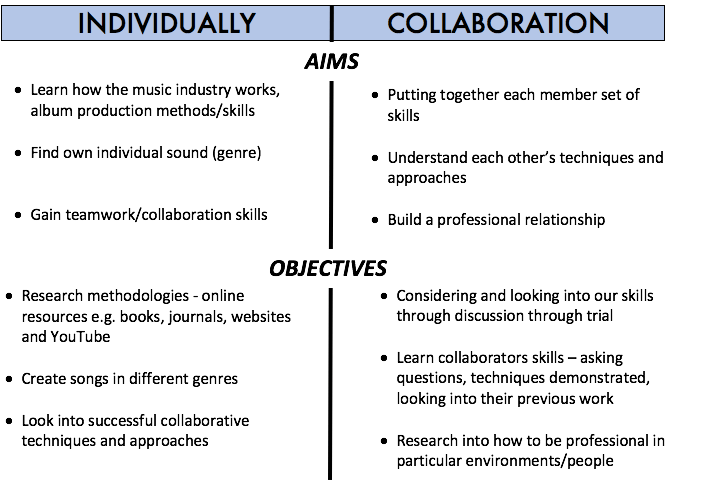
The main aims and objectives of this project both in a collaborative and individual way, is to (see fig 3.0.)
Figure 3.0. – Individual and Collaborative Aims & Objectives
MEET UPSESSION
After talking with Connor via Facebook, we organised to meet up as soon as possible (12th February) in order to discuss and begin planning the project.
During our first meet up session, we firstly looked at Connor’s past work to explore the WIP (work in progress) of creating each track. This was really helpful and Connor was able to provide me with face-to-face advise and information on the process of creating a 4 track EP, something he has experience in. I was also able to take some notes down in order to research further into how EP’s are created in terms of: production, mixing, mastering as well as looking into more musicological elements such as genre, instrumentation, structure, melodies and lyrics.
Below are some examples of Connor’s previous tracks, demonstrating in particular the quality of his work in terms of production and working with other artists!
DISCUSSING GENRES
Below is a Spotify playlist me and Connor have put together in order to gain an idea in the direction of styles we would like to explore for the EP. This is also to gain a sense of production in dance/pop songs and an insight into how collaboration works between producers and singers.
This playlist is also a really great idea as we will both be able to add varying song ideas to this playlist throughout the progress of this project. I will also really appreciate hearing Connor’s input of his own song suggestions and ideas rather than just my own selection.
COLLABORITIVE CHECK:
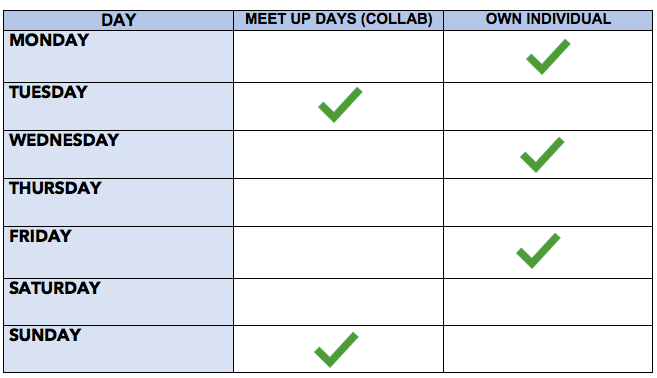
Below is our collaborative schedule that we have put together during our first session. However, at times, we will still need to discuss both of our availability due to Connors individual work schedule. I have also added my own schedule in terms of what day I will be working on this blog and other days that I will further work on this module in terms of contextual study and development.
Figure 3.1. – Collaborative & Individual Schedule
From our first session, it seems our collaboration has begun really well! Connor has shown his reliability through face-to-face meet up and we have been successful through organising a schedule for our next session (23rd February). I also really value Connor’s input of ideas and experience which is enhancing my understanding of what will need to be achieved to make this project successful.
What Next?
Further plan the EP
Research into methodologies/music industry
Continue to search for other collaborations
BLOG 2 –FINDING A COLLABORATOR
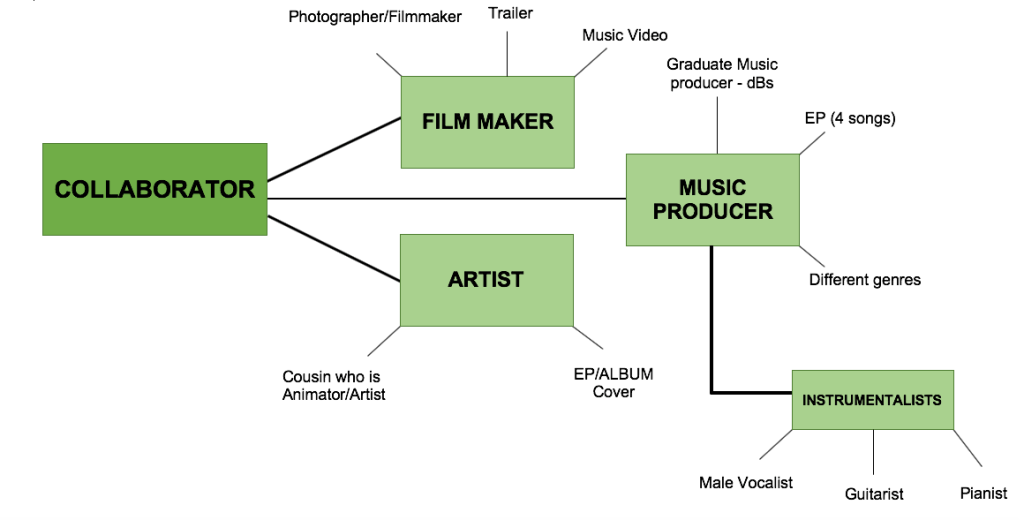
Below is a mind map of possible individuals that I could collaborate with during this creative project. However, my first aim as aforementioned, is to find a reliable music producer as a starting point.
Figure 2.0. – Collaborator Mind Map
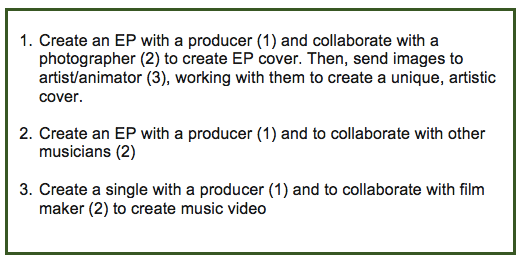
Because I have various ideas for this project, I believe that it will be possible to collaborate with at least two or more individuals (see figure 2.1.).
Figure 2.1. – Collaborative Ideas
These ideas vary and are possible outcomes for this project. However, it is important that I choose something that is suitable and reachable by the deadline – May 7th 2020.
COLLABORATOR ONE
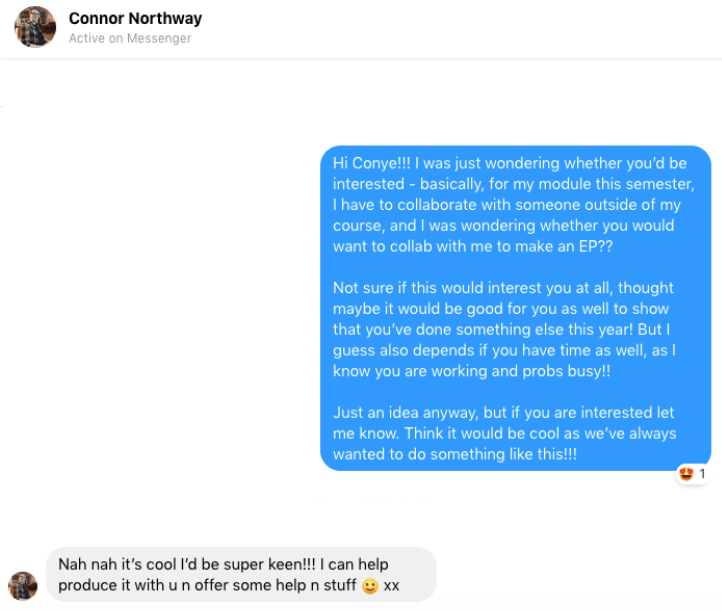
To ensure that this project idea is successful, my main aim is to find a music producer. Having worked with a music producer previously to provide vocals for their EP during their course at dBs music, I thought it would be a fantastic opportunity to work with them again! Below is our conversation via Facebook chat –
TIMELINE IDEA:
Below demonstrates a rough starting timeline idea and the main aims that I am hoping to achieve for this project. Because this is a starting point, this will change and further adapt throughout the progress of this project.
FEBRUARY 7TH: PROJECT BEGINS –
FINDING A COLLABORATOR: MUSIC PRODUCER
FEBRUARY 10TH: PROJECT PLAN –
BEGIN PROJECT REALISATION – WHAT WILL I DO?
FEBRUARY 12TH: RESEARCH –
RESEARCH INTO IDEAS TO CREATE AN EP
FEBRUARY 20TH: EXPLORE OTHER COLLAB IDEAS –
FIND OTHER COLLABORATORS TO WORK WITH
MARCH 1ST: BEGIN EP IDEAS –
TRACK IDEAS, GENRES…
MARCH 15TH: BEGIN OTHER COLLAB PROJECT –
THINK OF OTHER AREAS LINKED TO THIS PROJECT
COLLABORATIVE IDEAS:
When collaborating with somebody else, it is important to form a schedule where we are able to meet up at least once a week, face-to-face. This is suggested by Management Association (2017) who states that ‘face-to-face collaboration has a process gain of understanding’. Cooper (2018), also highlights five important areas of ‘in person’ collaboration. I have further adapted this to apply in a more musical sense for this project.
1) TRUST
Creating a reliable relationship and schedule – Once a week meet up (step-by-step, creating the tracks)
‘meaningful partnership’ – forming a relationship in this process through the music that is created
2) SHARING/COMMUNICATING IDEAS
Easier to speak/discuss ideas rather than through email – demonstrating methods or ideas through music softwares, e.g. Logic Pro X.
Able to learn these ideas/skills demonstrated in person – some things can’t be taught over email or through social media for music/album production!
3) EXPRESSION
Easier to understand things when said/expressions/emotions – e.g. when listening to each others musical ideas like a chord sequences, melodies or forming lyrics.
4) VALUE
‘time and effort’ – shows that they are reliable and are actually willing to take time out of their usual schedule to to help/collaborate.
Can lead to more collaborations in the future – learning to work with each other and if it has a positive outcome, then we can work together again to create more music!
Adapted from: Cooper, 2018
From this talk with Connor online, I believe that this could form something positive for the project. However, it is vital that I am still able to search for other collaborations in case this one does not succeed.
What Next?
Discuss and organise a meet up schedule
Exploreother collaborations as part of the project
Management Association, Information Resources. (2017). Remote Work and Collaboration: Breakthroughs in Research and Practice: Breakthroughs in Research and Practice. Hershey: IGI Global.
BLOG 1 – FIRST IDEAS
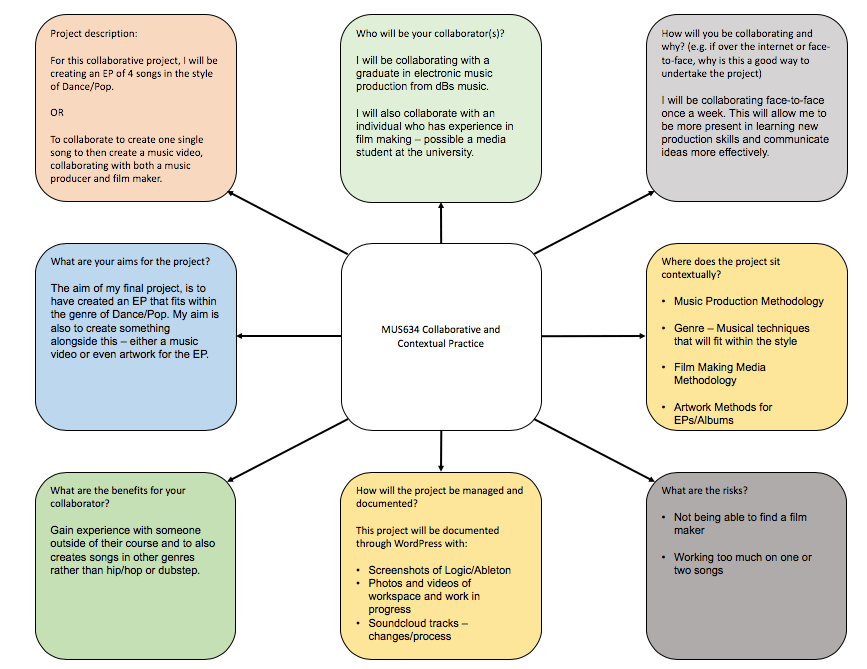
This blog will document and demonstrate the process of my project, containing research, photos, videos and audio. The main aim of this project, is to collaborate with various individuals who have experience in the field of music, film or the art industry. This could be a music producer, film maker or an artist who could provide collaborative work towards this musical project.
IDEAS:
To create an EP of 4 tracks
To create a music video to one single
To create art work for the EP
Below is a mind map from Lecture 2, providing an insight into my first initial ideas –
Figure 1.0. – Mind Map of First Ideas
What Next?
Find a music producer to collaborate with
Begin to plan and research how will this be achieved and time scale
 GEORGIA PAPANICOLA