BLOG 28 – FINAL CONTEXTUAL STUDY:
As I am now coming close to ending this project, it is vital that me and my collaborators consider copyright, royalties and authorship. These areas are vital to consider and to understand who has rights to the EP tracks. This is so that others do not claim credit for our work or use it illegally without permission. This is described by Marshall et al. (2013) who suggest that copyright comes in a number of forms. Copyright further highlighted by Slay (2011, p.880) who emphasises that ‘without copyright, songwriters and music publishers could not own and derive income from songs’.
COPYRIGHT & ROYALITIES
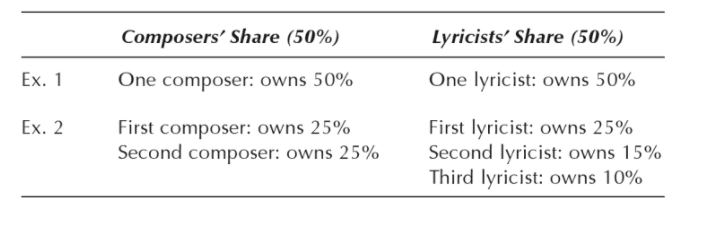
A written lyricist agreement may also follow as (see figure 29.0.), however this is most dependent on whether the Lyricist for the Greek track would like to be credited.
Figure 28.0. – Lyricist Rights Example
Source: Baskerville, 2006, p.92
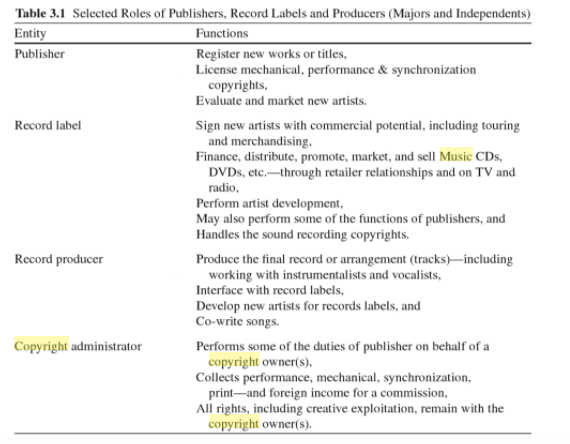
Figure 29.1. also demonstrates the various areas of the music industry in terms of Majors and independent artists, as well as how copyright works in this sense:
Figure 28.1. – Music Industry Areas
Source: Pitt, 2010, p.66
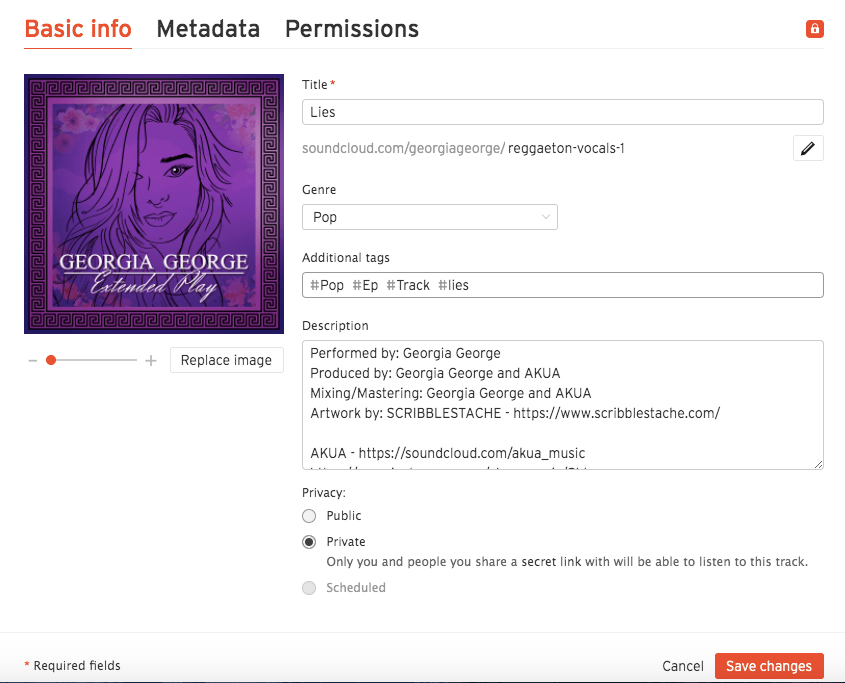
In terms of my project however, it is important that I give credit both to Connor the music producer for all four tracks and my brother who wrote the lyrics for the Greek track. This is something that me and my collaborators have discussed, but because this is a university project and an experiment into how collaboration works in the industry, we will mainly focus on authorship. This is mainly because we want to gain followers/fan base which will be done by (see figure 29.0):
Figure 28.2. – Authorship/Credit Example
What Next?
Now that I have looked into copyright and what I will do to credit my collaborators, it is now important that I begin to wrap up the final stages of the track. This will need to be done by listening through each track once more, then uploading and organising all information for each track on Soundcloud.
Reference List:
Baskerville, D. (2006). Music Business Handbook and Career Guide. London: SAGE.
PRS. (n.d.). PRS For Music. Available at: https://www.prsformusic.com/join [Accessed 29th, 2020].
Marshall, L., Frith, S. (2013). Music and Copyright. New York: Routledge.
Slay, M. (2011). Music Copyright Law, 1st ed. Cengage Learning.
Pitt, L, I. (2010). Economic Analysis of Music Copyright: Income, Media and Performances. New York: Springer Science & Business Media.
 GEORGIA PAPANICOLA