BLOG 4 – RESEARCH
In order for this project to be achieved successfully, I will be conducting research throughout the process of this EP creation. To gain an idea of the concepts of creating an EP, this particular blog will demonstrate different ideas and techniques as an initial starting point.
PROJECT AIM: WHERE WILL THE TRACKS BE POSTED?
Because I have now found a music producer to work with, my main aim is to create an EP of four tracks which will then be released on various social media platforms i.e. Facebook, Instagram and Twitter. The main music audio platform called Soundcloud, is where I will be submitting the final project realisation. I believe that Soundcloud will be the most successful in gaining listeners, this is mainly because I can post a Soundcloud link of the tracks directly onto other social media sites (Baby, 2012). Hiebner (2014, p.7) further emphasises that Soundcloud can be used ‘to promote your own creativity’.
Soundcloud is also an excellent platform for artists who are first starting out on the music scene or who are independent (Oswald, 2018, p.88). The platform also offers a free total of 180 minutes upload time (Soundcloud, n.d.), which is great for those who are just starting out or who cannot afford to pay a monthly subscription. This is particularly well suited for myself due to currently studying. Soundcloud has worked positively for upcoming artists like Jorja Smith where her single ‘Blue Lights’ (CAPITAL XTRA, 2019) became a hit (see figure 4.0.) as well as artists like Billie Eillish whose song ‘Ocean Eyes’ (see figure 4.1.) became popular hit and sparked her success as a musician (Marsh, 2017).
Figure 4.0. – Jorja Smith ‘Blue Lights’
Figure 4.1. – Billie Eilish ‘Ocean Eyes’
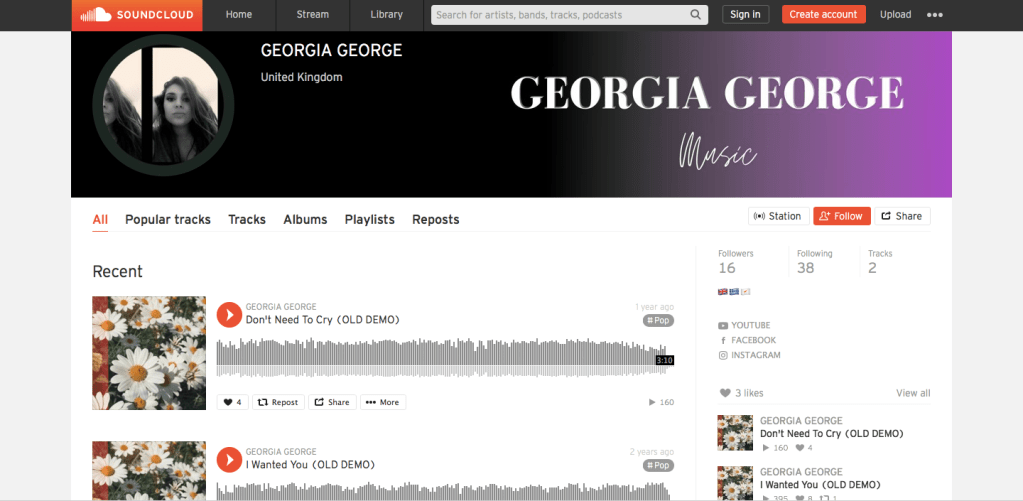
My Soundcloud Profile:
Because I have experience with Soundcloud in the past (with one song at nearly 400 listens), I believe that this platform has worked positively, especially because I was able to directly share the link to other social media pages, e.g. local Facebook pages like ‘Teignmouth Oracle’ and pages like ‘Greek Cypriots Growing Up in the U.K.’ where I am able to target a wide range of audiences to gain exposure.
Figure 4.2. – My Soundcloud Profile
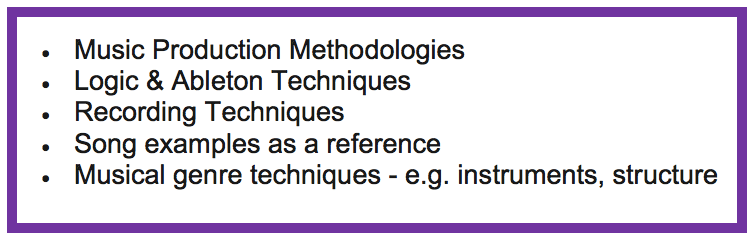
Another goal to gain from this project is to find my own individual sound of music, enhanced with Connor’s personal styles that he composes in. This could possibly be made up of a mixture of genres or even go down the root of one specific genre like Pop. However, it is important that I firstly research into these styles and methods (see figure 4.0.)
Figure 4.0. – Research Ideas
To understand the concept of creating an EP, I want to gain an idea as to what they are used for. This is expressed by Letang (2019) who states that:
‘the EP is great as a promotional tool. While singles are quick and easy to create, they don’t give people a full idea of what you can do’.
I found this particularly positive as it demonstrates great opportunity to explore varying genres and musical ideas that me and Connor will have in mind.
METHODOLOGY – MUSIC INDUSTRY
From a more professional perspective, Golding et al. (2012, p.23) highlight that, in order to become successful in this field, it’s important to maintain a well balanced lifestyle (see figure 4.3.).
Figure 4.3. – Balance and Key to Success
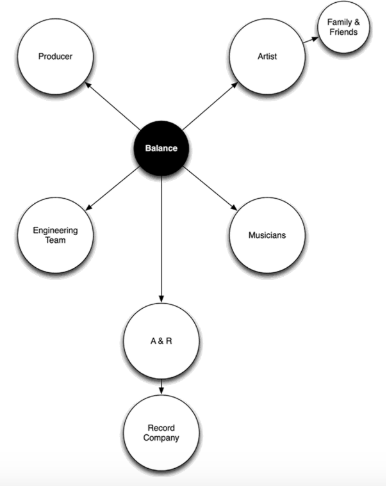
Source: Golding et al, 2012, p.23.
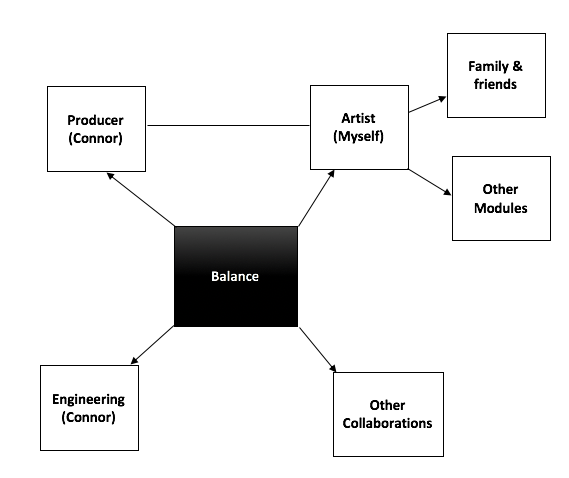
But because this is a university project, I have created my own diagram that demonstrates how I will keep this project well balanced in my personal situation and, along side other university modules (see figure 4.4.).
Figure 4.4. – Personal Balance
Hracs (2012, p.444), further adapts these ideas emphasising what artists and majors should consider in terms of recording studios, companies, promotion and more (see figure 4.4.).
Figure 4.4. – Traditional Model Controlled by Majors
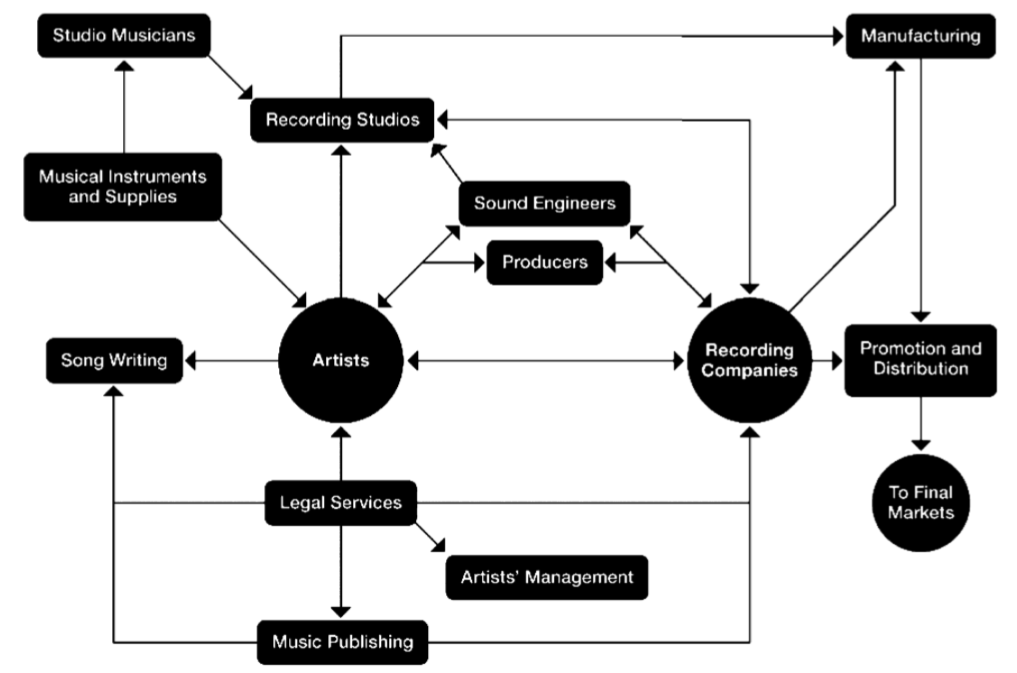
Source: Hracs, 2012, p.444
This allows me to gain a greater understanding of the music industry and shows that there is a bigger picture to music rather than just going into the studio. This is further highlighted by Weisman (2013, p.66) who emphasises that there is a lot that entails with being an artist and wanting to be successful in the music industry, rather than ‘just going into the studio with a producer and making beats’.
It is also important to consider other areas that professionals have to deal with in the music industry. For example, copyright and ensuring that mine and my collaborators music is protected. PRS for music (n.d.) suggest that ‘copyright of a musical work begins automatically once a piece of music is created and documented or recorded’. Marshall et al. (2013) further emphasise that copyright is an extremely complex area of study. This will be further examined in future blog posts to ensure that our creations are protected.
ALBUM PRODUCTION METHODS – STARTING POINTS
As a starting point, this is a brief overview of the main areas that me and Connor need to explore when creating the tracks as suggested by Leviatan (2017) –
SIX STAGES:
- ‘Songwriting’ – Chords, Melodies, Lyrics
- Arrangement – Instruments, Vocals
- ‘Tracking‘ – Recording
- ‘Editing‘ – Adjustments, Tidying
- ‘Mixing’ – Dynamics
- ‘Mastering‘ – Final Sound
Adapted from Source: Leviatan, 2017
What Next?
Now that I have done some brief research into creating an EP, it is now important that I follow these areas up and begin planning to form tracks with the music producer.
- Further research into methodologies of album production
- Find another collaborator
- Plan EP ideas
Reference List:
Baby, C. (2012). How to Promote Your Music with SoundCloud. Available at: https://diymusician.cdbaby.com/music-promotion/how-to-promote-your-music-with-soundcloud/ [Accessed 2nd May, 2020].
Billie Eilish. (n.d.). Soundcloud. Available at: https://soundcloud.com/billieeilish [Accessed May 2nd, 2020].
CAPITAL XTRA. (2019). Jorja Smith On Her Journey So Far | Homegrown | Capital XTRA. (Online Video). Available at: https://www.youtube.com/watch?v=zYIQKakSJZY [Accessed 2nd May, 2020].
Golding, C., Hepworth-Sawyer, R. (2012). What is Music Production?: Professional techniques to make a good recording great. Oxford: Taylor & Francis.
Hiebner, S., Hiebner, H. (2014). Social Media for Musicians: SoundCloud. Cengage Learning Trade.
Hracs, J.B. (2012). A Creative Industry in Transition: The Rise of Digitally Driven Independent Music Production. Growth and Change. Vol 43, No.3 (September 2012), pp.442-461.
Jorja Smith. (n.d.). Soundcloud. Available at: https://soundcloud.com/jorjasmith [Accessed May 2nd, 2020].
Letang, S. (2019). How To Make A EP Album – Step By Step To Extended Play. Available at: https://www.musicindustryhowto.com/how-to-make-a-ep-album-step-by-step-to-extended-play-perfection/ [Accessed 18th February 2020].
Leviatan, Y. (2017). Making Music: The 6 Stages of Music Production. Available at: https://www.waves.com/six-stages-of-music-production [Accessed 19th March, 2020].
Marsh, A. (2017). How Billie Eilish’s “Ocean Eyes” Turned Her Into an Overnight Sensation. Available at: https://www.teenvogue.com/story/how-billie-eilishs-ocean-eyes-turned-her-into-an-overnight-sensation [Accessed May 2nd, 2020].
Marshall, L., Frith, S. (2013). Music and Copyright. New York: Routledge.
Oswald, V. (2018). Indie Rock: Finding an Independent Voice. New York: Greenhaven Publishing LLC.
PRS for music. (n.d.) Available at: https://www.prsformusic.com/works/how-copyright-works [Accessed April 8th, 2020].
Soundcloud. (n.d.). Uploading Requirements. Available at: https://help.soundcloud.com/hc/en-us/articles/115003452847-Uploading-requirements [Accessed 2nd May, 2020].
Weisman, L. (2013). The The Artist’s Guide to Success in the Music Business: The “Who, What, When, Where, Why & How” of the Steps that Musicians & Bands Have to Take to Succeed in Music. Texas: Greenleaf Book Group.
 GEORGIA PAPANICOLA