BLOG 2 – FINDING A COLLABORATOR
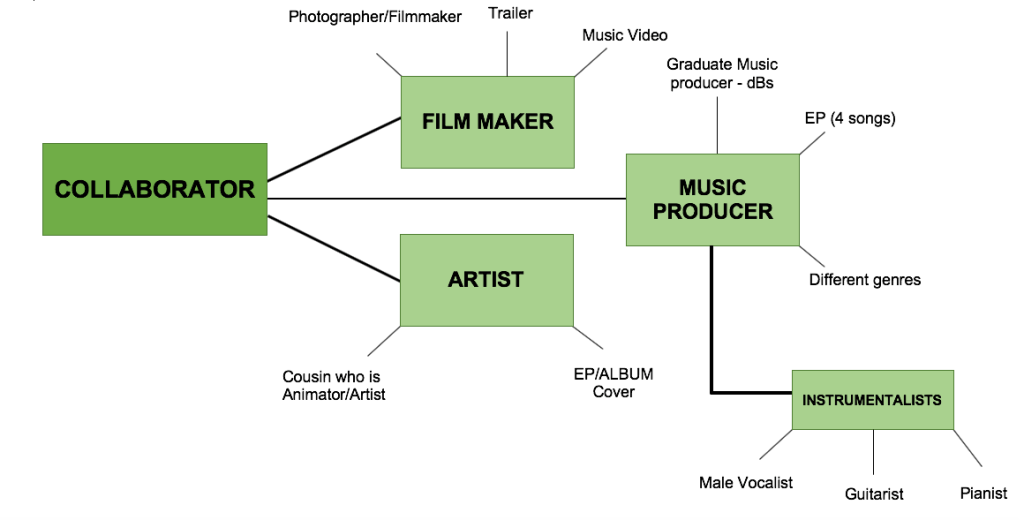
Below is a mind map of possible individuals that I could collaborate with during this creative project. However, my first aim as aforementioned, is to find a reliable music producer as a starting point.
Figure 2.0. – Collaborator Mind Map
Because I have various ideas for this project, I believe that it will be possible to collaborate with at least two or more individuals (see figure 2.1.).
Figure 2.1. – Collaborative Ideas
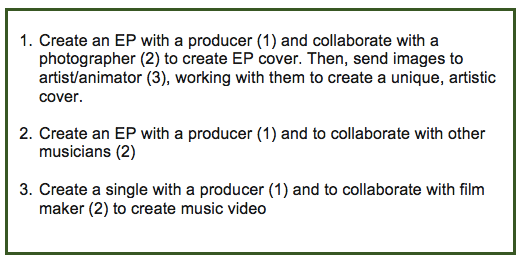
These ideas vary and are possible outcomes for this project. However, it is important that I choose something that is suitable and reachable by the deadline – May 7th 2020.
COLLABORATOR ONE
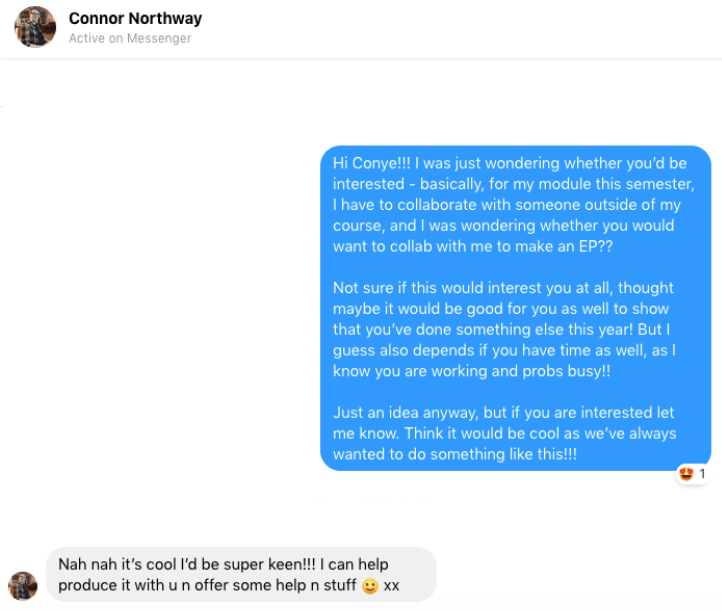
To ensure that this project idea is successful, my main aim is to find a music producer. Having worked with a music producer previously to provide vocals for their EP during their course at dBs music, I thought it would be a fantastic opportunity to work with them again! Below is our conversation via Facebook chat –
TIMELINE IDEA:
Below demonstrates a rough starting timeline idea and the main aims that I am hoping to achieve for this project. Because this is a starting point, this will change and further adapt throughout the progress of this project.
FEBRUARY 7TH: PROJECT BEGINS –
FINDING A COLLABORATOR: MUSIC PRODUCER
FEBRUARY 10TH: PROJECT PLAN –
BEGIN PROJECT REALISATION – WHAT WILL I DO?
FEBRUARY 12TH: RESEARCH –
RESEARCH INTO IDEAS TO CREATE AN EP
FEBRUARY 20TH: EXPLORE OTHER COLLAB IDEAS –
FIND OTHER COLLABORATORS TO WORK WITH
MARCH 1ST: BEGIN EP IDEAS –
TRACK IDEAS, GENRES…
MARCH 15TH: BEGIN OTHER COLLAB PROJECT –
THINK OF OTHER AREAS LINKED TO THIS PROJECT
COLLABORATIVE IDEAS:
When collaborating with somebody else, it is important to form a schedule where we are able to meet up at least once a week, face-to-face. This is suggested by Management Association (2017) who states that ‘face-to-face collaboration has a process gain of understanding’. Cooper (2018), also highlights five important areas of ‘in person’ collaboration. I have further adapted this to apply in a more musical sense for this project.
1) TRUST
- Creating a reliable relationship and schedule – Once a week meet up (step-by-step, creating the tracks)
- ‘meaningful partnership’ – forming a relationship in this process through the music that is created
2) SHARING/COMMUNICATING IDEAS
- Easier to speak/discuss ideas rather than through email – demonstrating methods or ideas through music softwares, e.g. Logic Pro X.
- Able to learn these ideas/skills demonstrated in person – some things can’t be taught over email or through social media for music/album production!
3) EXPRESSION
- Easier to understand things when said/expressions/emotions – e.g. when listening to each others musical ideas like a chord sequences, melodies or forming lyrics.
4) VALUE
- ‘time and effort’ – shows that they are reliable and are actually willing to take time out of their usual schedule to to help/collaborate.
- Can lead to more collaborations in the future – learning to work with each other and if it has a positive outcome, then we can work together again to create more music!
Adapted from: Cooper, 2018
From this talk with Connor online, I believe that this could form something positive for the project. However, it is vital that I am still able to search for other collaborations in case this one does not succeed.
What Next?
- Discuss and organise a meet up schedule
- Explore other collaborations as part of the project
- Begin to plan EP
Reference List:
Cooper, M. (2018). The importance of in-person collaboration. Available at: https://woodhouseworkspace.com/the-importance-of-in-person-collaboration-over-digital/ [Accessed February 26th 2020].
Management Association, Information Resources. (2017). Remote Work and Collaboration: Breakthroughs in Research and Practice: Breakthroughs in Research and Practice. Hershey: IGI Global.
 GEORGIA PAPANICOLA